Nikos Marinos
  • Home
    • BOOKING APPOINTMENT
    • 5things NEWSLETTER
  • Services
    • INDIVIDUAL PSYCHODYNAMIC PSYCHOTHERAPY >
      • THEORY
      • WHAT IS PSYCHOTHERAPY FOR?
      • WELCOME TO THERAPY
    • COUPLE COUNSELLING
    • CAREER COUNSELLING
    • PSYCHOTHERAPY ​FREQUENTLY ASK QUESTIONS _
  • About
  • ARTICLES
    • The Last Time I Cried in Front of a Man
    • The Labyrinth of Love
    • The Quiet Labor of Patience
    • Becoming Two Parents: A Gentle Guide for Couples Entering Parenthood
    • Boredom and Disconnection in Love
    • Becoming Two Parents: A Gentle Guide for Couples Entering Parenthood
    • The Space Between the Dots
  • Relational Integrity
    • ESSAY: Near Enough to Matter
    • ESSAY: Reinventing Psychoanalysis Anew
  • Staying With Series
    • ESSAY: Staying With the Eight Minutes/ Staying With: The Doors That Yielded

⊕ PSYCHOLOGY |  LOVE 
​

Stay or Leave ?

Wondering whether to stay or leave a relationship is a regular daydream of almost all committed people. It could not be otherwise, give the multiple sorrows to which love exposes us.


24.04.2017
​

Picture
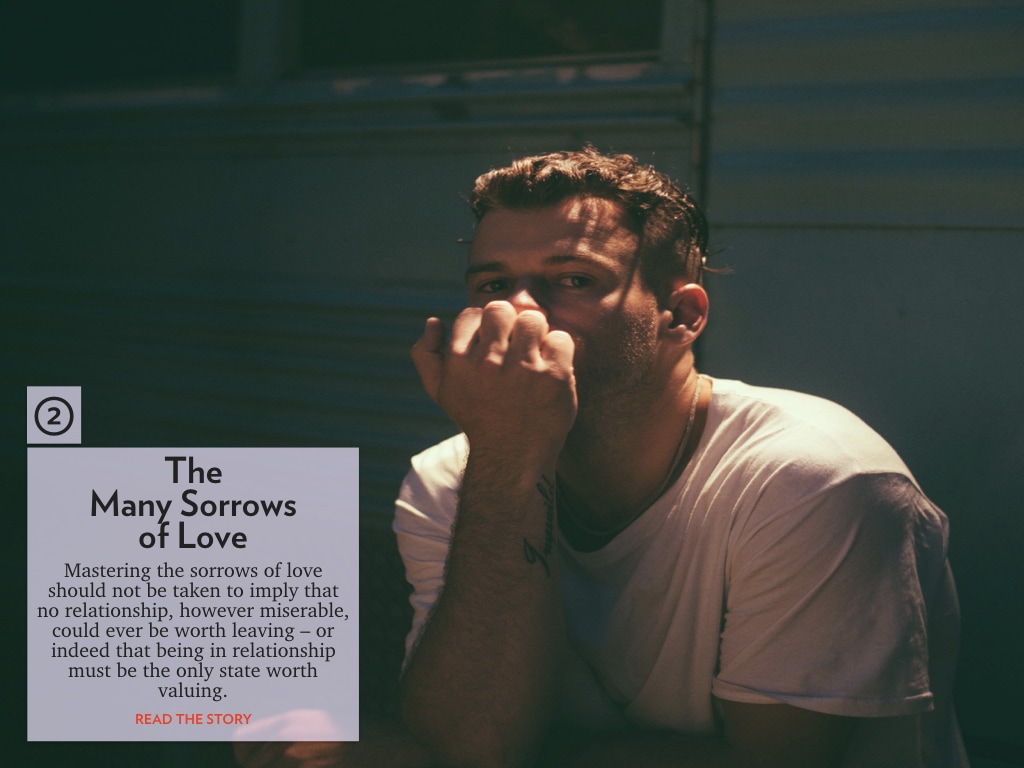
Mastering the sorrows of love should not be taken to imply that no relationship, however miserable, could ever be worth leaving – or indeed that being in relationship must be the only state worth valuing.

To the contrary, success at relationships is critically dependent on an awareness of when it might be wise to quit one and an honest assessment of whether relationships are even an arrangement to which we are psychologically suited.

Our age does us a huge disservice in this area by so rigidly equating normality and happiness with membership of a couple. We are made to feel as if there could really be no sane alternative to a life-long partner; as if every other possible arrangement would have to indicate a pernicious flaw in our character.

Other eras have not been as prescriptive. For most of the history of humanity, it was uncomplicatedly accepted that conjugal life couldn’t possibly suit everyone and that certain individuals would therefore need to remain single in order to make the most of their lives. Perhaps one was too taken up with work or had no interest in children, needed a lot of time on one’s own or got tetchy around large groups, was unusually devoted to God or liked to express oneself sexually outside of a loving union – in short, the best sides of oneself could not emerge from being with someone else all the time.

The name given to this choice was celibacy. The word is now often confused with chastity (the deliberate renunciation of sex) though it is quite different, indicating merely a decision not to entangle oneself emotionally with another, while otherwise remaining very open to sexual existence. It’s not so much that celibacy is forbidden in our society as that it is frowned upon. Some people live alone of course. But the default assumption is that they would ideally like to be with someone else – or should want to do be, were they were not somehow mad or mentally ill. Two hugely unfair and negative images accompany the term celibate in the cultural imagination; that of the spinster, the woman who no one wanted to marry. And the ‘confirmed bachelor’, the closet weirdo (perhaps gay) who is imagined as very much wanting to be with someone but prevented from finding fulfilment in a couple by social prejudice. The idea that someone might be perfectly capable of establishing a relationship and yet be deliberately and specifically choosing to live by themselves appears deeply frightening to our age – perhaps because we unconsciously sense in celibacy a freedom of which we’re profoundly jealous.

A truly evolved society would not be so aggressive in forcing its cohorts into couples. Only when being single truly has equal status with being in a couple can we be sure that people are pairing up for the right reasons, that is, on the ground of mutual attraction and psychological affinity, rather than in order to escape from social opprobrium. For all the vaunted liberations of our time, we need to liberate one last category, the celibate, from the weight of unfair prejudice and stigma. We need to offer closet celibates the chance to acknowledge and feel pride in their distinctive characters from the earliest age, so that they and their unlucky partners can avoid the unnecessary sufferings and recriminations of that deeply outmoded trap: the sham marriage.

Furthermore, though we need to be more determined and skilful about staying in relationships, at the same time, we need to grow a good deal more strategic and intelligent about knowing when to leave them.

Wondering whether to stay or leave a relationship is a regular daydream of almost all committed people. It could not be otherwise, give the multiple sorrows to which love exposes us.

In deciding how to answer the matter, the issue is not whether we are suffering or not. As we have seen, sorrows belong to the lives of all couples, even the best suited ones. The fact that we have many regrets – we have been considering at least ten here – should never in itself be a reason to end a relationship. Feeling furious and betrayed, shouting, resenting the laundry, fantasising sexually about other people, resenting that we’re not loved enough, rarely having sex… all these are elements that belong to highly workable and legitimate unions.

The moment to leave isn’t when we’re sad, it’s when we identify that our lover is contributing sorrows above and beyond those that belong to love in general, when aspects of their character are embittering life far more than the normal rules of relationships mandate and when we can see that the hurts we are facing don’t belong anywhere even on the dark and long list of woes provided by the Romantic Realist. It is then should accept that we aren’t simply being mature, we are unnecessarily ruining our lives.

Yet if, after an honest audit of our troubles, we come to suspect that our many griefs simply cannot be laid at the door our partner but are the work of that less blameful entity, life itself, then we should make our peace and stay put. We will know that we are encountering the misery of existence in the company of one particular person, but not – as it is so easy to presume – because of another person.

We will know we are sad not because love has gone wrong, but because it has gone just exactly as it was always meant to go.

MORE
STORIES
ON

LIBRARY


5things
​

WEEKLY BULLETIN

A weekly bulletin of the 5 most recommended articles, challenging ideas and interesting new things
​in Psychology from

​NIKOS MARINOS CONSULTANCY delivered straight to your inbox, every Monday.

    SUBSCRIBE
    TO OUR WEEKLY BULLETIN
    :

Subscribe

RELATED ARTICLES:
LOVE REALISM

Picture
Picture
Picture
​Call: +33 6 40 64 63 88
​Email: [email protected]

​
9 rue Saint Merri,
75004 - PARIS
Stay up today with my Newsletter
5things
  • Home
    • BOOKING APPOINTMENT
    • 5things NEWSLETTER
  • Services
    • INDIVIDUAL PSYCHODYNAMIC PSYCHOTHERAPY >
      • THEORY
      • WHAT IS PSYCHOTHERAPY FOR?
      • WELCOME TO THERAPY
    • COUPLE COUNSELLING
    • CAREER COUNSELLING
    • PSYCHOTHERAPY ​FREQUENTLY ASK QUESTIONS _
  • About
  • ARTICLES
    • The Last Time I Cried in Front of a Man
    • The Labyrinth of Love
    • The Quiet Labor of Patience
    • Becoming Two Parents: A Gentle Guide for Couples Entering Parenthood
    • Boredom and Disconnection in Love
    • Becoming Two Parents: A Gentle Guide for Couples Entering Parenthood
    • The Space Between the Dots
  • Relational Integrity
    • ESSAY: Near Enough to Matter
    • ESSAY: Reinventing Psychoanalysis Anew
  • Staying With Series
    • ESSAY: Staying With the Eight Minutes/ Staying With: The Doors That Yielded