Nikos Marinos
  • Home
    • BOOKING APPOINTMENT
    • 5things NEWSLETTER
  • Services
    • INDIVIDUAL PSYCHODYNAMIC PSYCHOTHERAPY >
      • THEORY
      • WHAT IS PSYCHOTHERAPY FOR?
      • WELCOME TO THERAPY
    • COUPLE COUNSELLING
    • CAREER COUNSELLING
    • PSYCHOTHERAPY ​FREQUENTLY ASK QUESTIONS _
  • About
  • ARTICLES
    • The Last Time I Cried in Front of a Man
    • The Labyrinth of Love
    • The Quiet Labor of Patience
    • Becoming Two Parents: A Gentle Guide for Couples Entering Parenthood
    • Boredom and Disconnection in Love
    • Becoming Two Parents: A Gentle Guide for Couples Entering Parenthood
    • The Space Between the Dots
  • Relational Integrity
    • ESSAY: Near Enough to Matter
    • ESSAY: Reinventing Psychoanalysis Anew
  • Staying With Series
    • ESSAY: Staying With the Eight Minutes/ Staying With: The Doors That Yielded

THEORY |.  PSYCHOLOGY

​

Picture


​Maslow's Hierarchy of Needs Is Incomplete — There’s a Final, Forgotten Stage​


Nichol Bradford
Strategy and Marketing Expert​

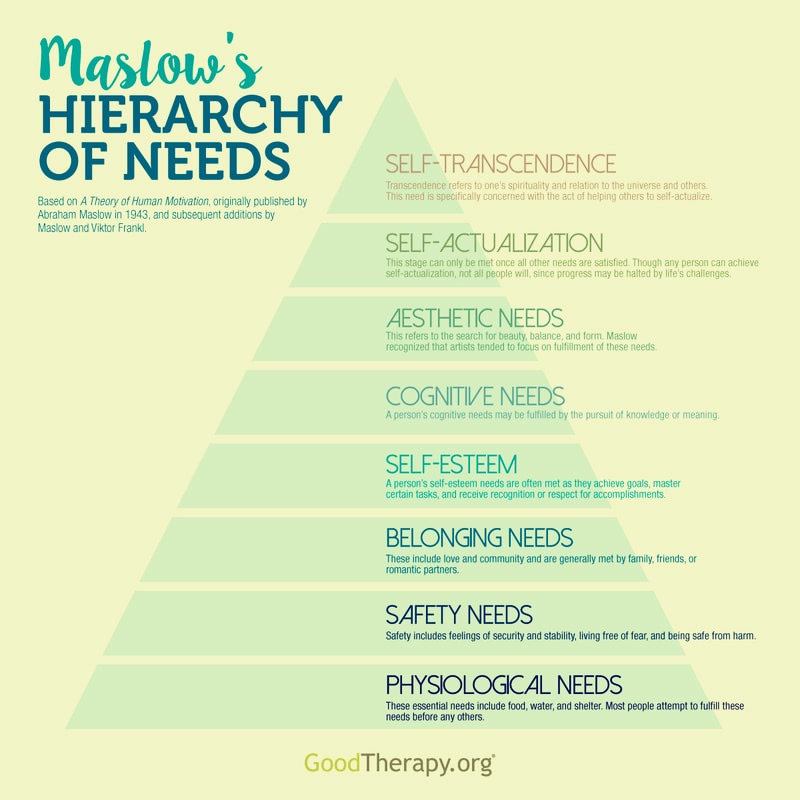
Maslow's Hierarchy of Needs has served as the foundation for understanding human motivation since it was first published in 1943 as part of "A Theory of Human Motivation" in Psychological Review. The hierarchy, visualized in pyramid form, is often given as an introduction to human psychology and still holds weight in population conversation about what humans need from life, and in what order they need it.

Picture
But Maslow's hierarchy as we commonly know it is incomplete, says Nichol Bradford. Later in his life, after the hierarchy had been published, Maslow began work on a final stage of human motivation. Self-actualization was not the pinnacle of individual human achievement, but rather self-transcendence. Not an elevation of the self, but a subverting of it.

This takes us to different perspectives on human psychology itself. Achieving self-actualization means resting comfortably inside the boundaries of human psychology — accomplishing what is knowable and testable — while self-transcendence means pushing beyond them. Whether through spiritual meditation, self-denial, or more recently through technological means, challenging the definition of consciousness to expand into new areas of knowledge — beyond self-knowledge — may be the ultimate stage of human development.

One technological path toward self-transcendence is the singularity, an event in which human biology and computers become one. Integrating hardware and software into the flesh and mind of our bodies represents an opportunity to literally overcome our present physical limitations. While this may yet prove a promising endeavor, Bradford says human problems still have human solutions. Overcoming the narrow confines of the self may be as simple as giving yourself over to others: their dreams, their goals, their passions. And by doing so, you become one with them.


Picture
Picture

MORE ON THEORY:
​

Picture
What Happens in Psychotherapy
READ MORE
Picture
Existential Psychotherapy
READ MORE
Picture
The Unconscious in Clinical Psychology
READ MORE
Picture
What’s the Difference between Psychotherapist, Psychologist, Psychiatrist, Psychoanalyst and Counsellor?
​
READ MORE
​Call: +33 6 40 64 63 88
​Email: [email protected]

​
9 rue Saint Merri,
75004 - PARIS
Stay up today with my Newsletter
5things
  • Home
    • BOOKING APPOINTMENT
    • 5things NEWSLETTER
  • Services
    • INDIVIDUAL PSYCHODYNAMIC PSYCHOTHERAPY >
      • THEORY
      • WHAT IS PSYCHOTHERAPY FOR?
      • WELCOME TO THERAPY
    • COUPLE COUNSELLING
    • CAREER COUNSELLING
    • PSYCHOTHERAPY ​FREQUENTLY ASK QUESTIONS _
  • About
  • ARTICLES
    • The Last Time I Cried in Front of a Man
    • The Labyrinth of Love
    • The Quiet Labor of Patience
    • Becoming Two Parents: A Gentle Guide for Couples Entering Parenthood
    • Boredom and Disconnection in Love
    • Becoming Two Parents: A Gentle Guide for Couples Entering Parenthood
    • The Space Between the Dots
  • Relational Integrity
    • ESSAY: Near Enough to Matter
    • ESSAY: Reinventing Psychoanalysis Anew
  • Staying With Series
    • ESSAY: Staying With the Eight Minutes/ Staying With: The Doors That Yielded